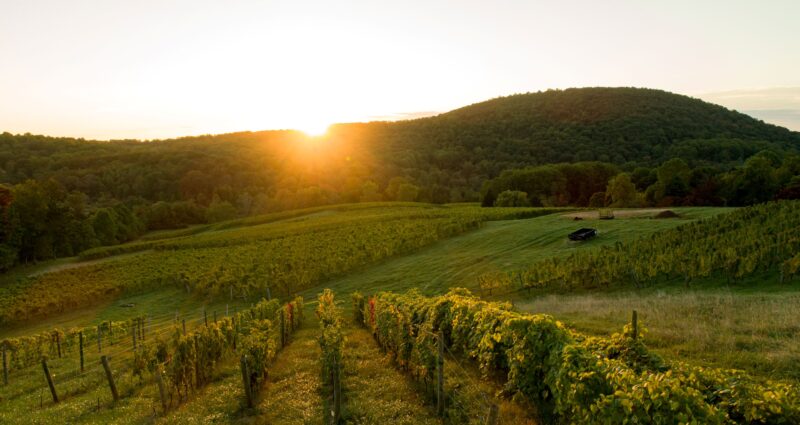
America turns 250 this year, and it’s a moment to celebrate the ideas, ambition, and landscapes that helped shape the nation. Few stories connect past and present quite like Virginia Wine.
Where American Wine Began
Wine has been part of Virginia’s story from the very beginning. Vines planted by Jamestown settlers in 1609 marked the earliest vision of Virginia as a winegrowing region.
Early efforts were fueled by the idea that wine signaled permanence and promise. European vines and native grapes behaved differently than expected, but growers persisted. They trusted Virginia’s soils, climate, and varied terroir, laying the groundwork for American wine.
A Legacy of Persistence and Progress
Virginia’s wine history reflects long-term commitment and steady progress. For more than 400 years, wine has remained part of the Commonwealth’s agricultural landscape, developing through periods of challenge and growth that often paralleled the nation’s history.
This confidence in Virginia’s potential was shared by Thomas Jefferson, who spent years planting vineyards and testing grape varieties at Monticello. Although early results were limited, his work reinforced the idea that Virginia could produce high-quality wine.
In the 19th century, progress accelerated with the development of Norton, America’s oldest native wine grape. First cultivated in Richmond in the 1820s, Norton proved well suited to Virginia’s climate and soils. Its durability and capacity to produce structured wines gained international attention at the 1873 Vienna World’s Fair.
Virginia’s wine industry persisted through disease, economic change, and prohibition. When the modern industry reemerged in the late 20th century, it was supported by improved vineyard practices, expanded research, and a renewed emphasis on quality.
Virginia Wine Today
Today, Virginia Wine reflects both its history and its momentum. The Commonwealth is home to more than 300 wineries across 10 wine regions and 8 AVAs, with over 5,000 acres of planted vineyards. This diversity of geography, climate, and approach allows winemakers to produce a wide range of styles while remaining grounded in place.
Across the state, producers balance tradition with innovation, guided by research, collaboration, and a shared commitment to excellence. Shaped by the land and the people who farm it, Virginia Wine continues to evolve.
As America marks 250 years, Virginia Wine raises a glass to its history, its progress, and what comes next, remaining a vital part of the American wine story. Looking for more ways to celebrate the Commonwealth? The VA250 Commission is sharing events and opportunities to get involved.

More Virginia Wine Stories
December 19, 2024
Norton: Virginia Native
Through its evolution, Virginia’s winemaking community has discovered the grape varieties that define the state—producing wines that are elegant, expressive, and unmistakably Virginian. With over 30 varieties planted, including Norton, […]
Read More
January 8, 2026
10 Ways to Plan Your Next Virginia Wine Adventure
Every corner of Virginia Wine country offers something worth discovering, and your Virginia Wine account helps guide the way. From planning your next tasting to finding Virginia Wine close to […]
Read More
November 20, 2025
Understanding Virginia’s Hybrids
Hybrid grapes provide practical benefits while also producing vibrant, expressive wines that fit naturally in the Commonwealth’s wine scene. They are becoming some of the most notable wines in Virginia, […]
Read More